
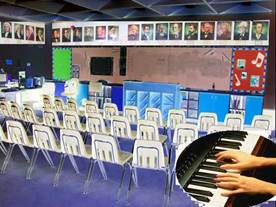
 A student of the Music Department walked into the classroom. The classroom was not as big as a music hall or a concert hall, basically it was still placed with a piano. On the piano, there was a copy of the brand new music script and ten students sat down in the room.
“Oh dear! It’s another extremely difficult one.” He mumbled to himself as he flicked through the pages. He felt that the confidence he had in playing the piano fell straight to rock bottom, and was completely extinct.
It had been almost two months since he started learning from this new professor and he did not know why the professor adopted his teaching method to give him a hard time. He tried to summon his spirit up again, and started striving and battling with his ten fingers with all his might and strength. Absorbed in total concentration and with the continuous notes from the piano, he managed to cover the sound of the professor’s footstep as he walked to and fro around the classroom.
I can remember the day of the very first lesson; the professor gave all the students a copy of music script. “Let’s try it out and see!” he said. The script was of quite a high level. The students played the music not in a smooth way and with no feeling, and also made numerous mistakes. “Still not familiar with it, you must practise more at home!” urged the professor repeatedly at the end of the lesson.
In the second lesson of the following week, the students had already practised for one week, and they could not believe it when the professor handed them another music script that was even more difficult. “Let’s try it out and see!” The professor did not mention last week’s homework. All the students once again struggled in the challenge of playing at an even higher level of difficulty.
In the third week, an even more difficult music script appeared. The professor did not say a word. Rumour had it that the professor was supposed to be a highly acclaimed piano master. It could be a name without substance!
In the fourth week, an even more difficult music script appeared again. The professor said only one sentence, “Umm, average, average.” It is probably quite common that artists do not like talking much.
In the fifth week, an even more difficult music script appeared. The same situation repeated. Not only this, I knew that I was the worst student, and in my heart I knew this only too well, yet I was chosen to come forward and play in front of the others. Obviously, I was forced to come out and perform.
In the sixth week, the same situation repeated: an even more difficult music script appeared. I was chosen to lose face again for demonstrating in front of others.
The students were given a new music script in every lesson and they were stuck. They took the scripts home to practise. Then they were back in class they would have to face yet another music script which was twice as difficult. One could hardly keep up with such standards. There was no sense of achievement from the practice they all made during the week. The students were getting more and more uneasy, depressed and discouraged.
After three months, it was not yet time for examinations, but I did feel that there might be a test. When the professor walked into the classroom, I could not hold back any more, I had to question the piano master. Why did he put me under such a grilling pace during the last three months? Hopefully, this might stop him from picking on me to demonstrate in front of the others again and making me receive the lowest grade in class.
The professor did not reply and turned to everyone and said, “Today there’ll be a test, all of you, classmates must imagine that you’re the audience and also the examiners who are responsible for assessing the performance in a concert. I’ll hand out a scoring sheet for each student; the scoring sheet is divided into four sections: 0-point represents total ignorance, 1-point represents a fail, 2-point represents a pass (average standard), 3-point represents a good performance, and 4-point represents an excellent performance.”
He drew out the ‘first music script’ and passed it to me. “Play!” He looked at me with a determined gaze. Oh! We were really given a test today, my prediction was accurate, I thought to myself.
The most unexpected thing happened. I was also very astonished myself. I suddenly managed to play the piece of music with such beauty and perfection! The professor asked me to try and play the music from the script given in the second lesson. I still managed to achieve a very good performance. When I finished, all the students stared at the teacher and could not say a word.
The professor collected all the scoring sheets. Ten students each gave 4 points, 40 points in total. The professor went to get his own scoring sheet from the side of the piano. He passed it round for the other pupils to read. Apart from comments, the score was 59 points. So the result of the test was 99 points!
“If I had allowed you to choose and play your own favourite parts, you would have still been practising from the first script I gave you. It would have been impossible for you to have reached the standard you’re at now,” the piano master said slowly.
z z z z z z z z
Human beings, always perform whatever is the most familiar to them out of habit, and whatever territory they are most skilled in.
But, if we wish to look back, examine carefully, we will fully understand. Faced with tight and menacing work conditions and challenges, with ever increasing levels of difficulty and high pressured surroundings, unknowingly and unconsciously, one can develop today’s various skills and abilities.
Human beings, actually have unlimited potentials! When we reach the level of cognition and understanding as mentioned above, we will be happier to accept more difficulties and questions in the future!
z z z z z z z z
Rinpoche educates us all the time and gives us discourse.
In the beginning, everyone happily accepts. Maybe it is due to a new spiritual teacher with fresh feelings.
A few years later, someone starts to complain.
After ten years or more, somebody cannot suffer Rinpoche’s chilly personality, stern face, less talking, test…. Many followers left.
After twenty years or more, evil spirits arise within the disciples’ hearts (maybe due to the fact that they have attained a certain level in their cultivation and now encounter tests from the devils), they feel that they have achieved a sense of satisfaction, have become a big Bodhisattva, and want to go public and save sentient beings. On the other hand, they see and regard their own Guru as the devil! The disciples think they are more and more able and consider their Guru becoming ineffective and disorderly. It is better to kick him away or leave him early. On the contrary, Rinpoche would say, “Very good, my teachings have paid off if my disciples are better than I am, with great achievements, can understand Buddhist theory better than I can, and are more familiar with the principles of dharma practice than I am. This fulfils the ideal of ‘education and linear tradition’. My sense of achievement is thus greater and my supererogation is much greater. I must sincerely thank all my disciples who have helped to make these achievements possible!”
| We gave this essay to Rinpoche to read. Once finished reading, Rinpoche sighed and said, “ | |
| 1. | Even a piano teacher has already adopted a teaching mode that’s with such strictness, without emotion, and with such high level of difficulty. Needless to say that I’m a teacher of Vajrayana! My teaching method has always been much stricter and more emotionless than that of the piano master; this is because I teach the dharma that transcends the material world. |
| 2. | I’m happy for the piano master because he’s found a successful student. Moreover, this student, at the very least, knows how to understand and appreciate him. There’s an old saying: Go a thousand miles to find a Guru. I would rather say: Go ten thousand miles to find a disciple! |
| 3. | The fault doesn’t lie on my disciples. They just lack wisdom temporarily, or maybe it’s karma that overcasts their Buddhist instinct. One day when they grow up, they’ll understand. |
| 4. | The fault should lie with myself. It was I who failed to educate them and turn them into ‘good dharma tools’. Of course, without becoming a ‘good dharma tool’ naturally one can’t sustain tantric dharma. Buddhism fundamentally has two sections: exoteric and esoteric. Exoteric Buddhism mainly focuses on soft teachings, whereas Esoteric Buddhism mainly focuses on hard teachings. It’s normal that many people can’t accept my mode of teaching. Probably their links (conditions) in this life are not with tantric dharma or their links (conditions) with me are not compatible. If we were to carry on reluctantly, it could end up being their nightmare! Since this is not good for them, then why carry on! It’s better to silently give them a blessing, wishing them success in quickly finding a Rinpoche who is better than I’m and in finding a better Guru.” |
