
The Joy of Looking Forward to Tomorrow – India
Source: The Internet
In Buddhism, Bodhgaya is the most significant holy site amongst the four major ones, because this is the place where Sakyamuni Buddha obtained Buddha enlightenment. In the era of the Indian Emperor Ashoka Maurya, a Mahabodhi Temple was built here, but now only the Abode remains. It was reconstructed in the 19th century. From November to March of the following year, the temperature here is rather cool and full of sunshine which is very suitable for meditation and dharma practice. Every year at this time, many pilgrims and Buddhist monks and nuns from all over the world come here for retreat.

Every morning at dawn, whilst the fog had not yet dispersed, there would be fifty to sixty lamas at the Mahabodhi Temple practising prostrations, some would be under the Bodhi tree, some at the long corridor by the side of the main hall or at other corners.
In the garden behind the main hall of the Abode, a lama, dressed in a red robe and sat cross-legged, was reciting the sutra. The sound of sutra-reciting was short, strong and with resonance. Two young lamas were blowing ten-meter long bronze horns, its low tone reverberating, wu … … … a noise similar to the tongue touching the top palate and resounding through the nose, emitting right into the sky as the vibrations were felt in the heart.
Prostration is a way to pay homage to Buddha, with the meaning of taking refuge in Buddhism and repentance. The action is touching the ground with hands, both knees and forehead at the same time. Most lamas pledge to do one hundred thousand prostrations before leaving Bodhgaya.
This was the first time I had seen so many lamas doing prostrations. Both stunned and moved, I thought to myself: why did they practise so diligently? Prostration, apart from having the religious meaning, in my eyes had a sense of sophisticated beauty, which refreshed and vitalised my mind. After I had taken some photographs for a few days, I could not help but practise prostrations myself. On the first day, I could only practise fifty times. Due to my incorrect posture and applying force at the wrong places, my whole body ached the next day. 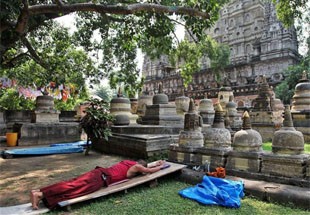 I could not raise my hand, even turning in bed was difficult and I even had chest pains when I laughed. However, I sensed an inner joy and because I was so moved by the surrounding atmosphere, I persisted in practising.
I had practised a session of prostrations every morning and afternoon respectively before I started my photography. From the first fifty counts, I continued to increase to one hundred times, then the last few days, I practised around two hundred times every day. During the process of practising prostrations continuously, with pain throughout my whole body, I personally experienced that this could cultivate concentration and perseverance. With the attitude of enabling others to develop their intuition, my spirits of taking photographs became even more focused and pure.
Every day, life here was very simple with nothing more than taking photos, walking and practising prostrations, however, my inner mind was filled with satisfaction and pleasure. In Taiwan, daily life was busy, goods and materials were abundant, but no matter whether it was working, living, or eating, it was difficult to feel fully satisfied. Everything in life originates from the feeling of contentment in the inner mind. However, the more anxious we feel, the less content we feel; the inner mind works like a black hole, which is impossible to be fully filled.
At dusk, the Abode was showered in the colour of golden yellow by the sun and the leaves from the Bodhi tree drifted down with the wind, gently rolling in the sunlight. I sat quietly in one corner of the courtyard at the Abode, under the shade of a gigantic ancient Bodhi tree, facing a tall ancient pagoda.
This time, the sky was covered in a thin layer of mist and getting dark. A few lamas started to light candles on the low surrounding walls of the courtyard at the Abode, making the whole Abode similar to an auspicious, peaceful and beautiful magnetic field. Being here, my mood was like the moon in my smiling eye, with the joy of peace, tranquillity and contentment.
This kind of peace, tranquillity and happiness made one have a certain type of hope for ‘tomorrow’. Before going to bed every day, it made me hope for the first beam of dawn to hastily arrive and for the sky to quickly brighten up. As soon as the sun rose, I would go to the Abode to take photos, to be near Buddha, to meditate and to practise prostrations. In life, I have long missed experiencing the joy of looking forward to the arrival of tomorrow!
During my travel, I met a friend called Loygi Tsenten. Last year in September, he and twenty Tibetans started from Lhasa, crossed the Himalaya Mountains, to reach India. They did not have any passports. He said, “Passports are under our feet.” They walked at night, slept during the day, crossing one mountain after another. In September, the Himalaya Mountains were covered in snow. When they walked at night, they were tied to each other one after the other. When they felt hungry, they washed down green cake flour with snow. Before they arrived in India, they had finished all the green cake flour. They had not eaten for seven days. Among them, a nineteen-year-old young boy physically could not tolerate any more, hence vomited blood and died.
They had risked their lives, endured extreme hardships, with the aim to reach Dharamsala in India. He expressed a smile of satisfaction, as if all that hardship had passed; this was the power of faith which enabled him to cross the Himalaya Mountains.
His story made me think of myself, who was naturally timid, easily frightened, often like a lost soul walking on roads and was often panic-stricken when crossing streets. However, due to photography, I would often manage to do things which I considered unachievable. Nine years ago, I did not know any French, nor was my English fluent. In spite of all opposition, I went to France to study photography. I travelled from Western Europe to Eastern Europe, travelling for two months and then further to North Africa. All these strengths originated from my persistence in photography, which was exactly the same frame of mind as those pilgrims. How could they be so brave by ignoring all the dangers to complete their journey? This was because they believed: When the pilgrimage was accomplished, great fortune and reward would follow and life would become peaceful and calm. At the time, my frame of mind was this: As I had come to a crossroad in photography, I believed that I would have made progress if I had studied in France and that I would have a breakthrough in photography if I had travelled far and wide to take pictures. With this frame of mind, my willpower was like steel, just like a warrior who was determined to attack up to the mountain top, he could only see the hills with his eyes, but could not see the thorns and brambles everywhere on the ground.
Ideal is also a belief. To firmly adhere to an ideal and to firmly commit to belief and faith, the power is the same.
