
Explanations of Difficult Sentences
Is it really so difficult to understand or it is only that I have not yet tried hard to understand? Do I habitually ask questions without thinking in advance? Rinpoche has high expectations. First of all, when we are dealing with the original texts of Buddhist Sutras, the original texts of Tantric scriptures pertaining to Esoteric traditions rooted in Buddhist philosophy, gatha (a short verse recited in rhythm with the breath as part of mindfulness practice, either in daily life or as part of meditation) as well as Buddhist allegorical words and verses from Patriarchs etc., for example, 50 Stanzas on Devotion to the Guru《事師法五十頌》, The Prayer of Kuntuzangpo《普賢王如來祈禱能顯自然智根本願文》, Ode to Samantabhadra Yabyum with strong wishes《普賢王如來大力願頌》, The Elegant Sayings of Sakya Pandita《薩迦格言》, Seventy Verses on Sunyata《七十空性論》and Great Perfection Trilogy of Natural Freedom《大圓滿三自解脫論》, Rinpoche does not only demand us to read, view and think about them for several more times, but also requires us to comprehend them personally with whatever means we can employ. Rinpoche says, “If you come across something you can’t understand, it may probably be one of the following two circumstances;
1) Encountering difficult words, complicated phrases or polysemous expressions may stop you from continuing reading; these are language barriers which make you feel that the scriptures are too intricate and abstruse to comprehend. You’re said to be ‘hold’ (from your reading) colloquially. In that case, you’d better not to be discouraged. Try looking up dictionaries or thesauruses before going on reading and keep on thinking about the scriptures.
2) Having read the scriptures for a number of times but still unable to understand, it means that your comprehension ability is rather weak. In this way, you should take your courage in both hands and advance bravely; try to be detached first by either having a nice sleep till daybreak or practising a sit of meditation which can be helpful in easing the situation.
It is not until you’ve gone through the two situations mentioned but to find that your problems remain unsolved before you go and search for decoding reference books. With the advancement in information at modern times, you can get even more guided-reading materials as well as annotations in the Internet to assist your comprehension (of the scriptures) so that you’re made to understand them. However, the comprehension and understanding belong only to the authors of the decoding reference books, the writers of the guided-reading materials or interpreters in the Internet. It’s their understanding and ‘enlightenment’ instead. You’ve only accepted their understanding and ‘enlightenment’, but well, it’s not equal to the situation that you have attained the ‘enlightenment’ by yourself!”

Rinpoche requests us to read (scriptures) for several more times and also to think over them for several more times. Once, twice, thrice, four times…, think long and hard. One day, you will find yourselves able to comprehend and grasp the gist behind in which your understanding is perhaps better than others’ interpretations or there may even be a breakthrough. This is known as the manifestation of wisdom. Hence, Rinpoche does not encourage us to read the vernacular Chinese translations, interpretations or analysis etc. of the scriptures at the very beginning so as to avoid our running into the direction of getting into the blind alley of texts (for fear that) when we try to excavate their deeper meanings, we will be deviated from pragmatic spiritual practices. Rinpoche adopts the heuristic way of teaching so that we are guided to learn in the self ‘enlightened’ way which is what Buddhism is all about.
Different from the world’s classroom-teaching or ‘duck-stuffing’ type of teaching, Buddhism emphasizes the ‘enlightened’ teaching method. Enlightenment in Buddhism is not only valued in the Zen sect, but it is also highly treasured in various sects and groups. It can even be said that the entire Buddhism is talking about how to become enlightened in order to attain Buddhahood.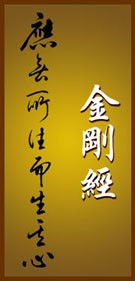
One of the main ideas of Diamond Sutra is to make people achieve enlightenment by themselves. The Buddha told Venerable Subhuti, “If there’s a good man or a good woman who can comprehend and accept four lines of gatha in this Sutra and then speaks and explains them for other people, the blessings and virtues he (she) will be received surpass the ones those people received by offering precious gems as many as the Threefold Great Thousand World Systems.” The Great Master Huineng, the sixth patriarch of the Zen sect attained his enlightenment because of a sentence in the Diamond Sutra, “One should produce a mind which does not rely on anything.” It is unlikely that everyone who has read this sentence will be enlightened! This is only the distinct opportunity for the sixth patriarch. Anyway, if one can comprehend any line or half of the gatha in the Diamond Sutra, one can come to realize one’s own mind. One can thus convert klesa (pain, affliction and distress) into Bodhi (enlightenment) and will be free from falling to hell anymore.
We read the Diamond Sutra every day and have already read it for (more than) a thousand times altogether, but we have not yet achieved enlightenment. Having heard a sentence in the Diamond Sutra, “One should produce a mind which does not rely on anything.”, the Great Master Huineng, the sixth patriarch of the Zen sect became enlightened immediately. As a result, the Great Master Hongren, the fifth patriarch passed on the Buddha Dharma as well as the monk’s mantle and alms bowl to Huineng and made him the sixth patriarch. Many practitioners hope that they can be enlightened at once. After reading some books and having practised cultivation for some years, one thinks that one has become enlightened. Actually, one has merely understood some of the principles. As for whether one is enlightened or not, it should be affirmed by Mahasiddha (great achievers).
Last but not least, it has to be clarified that you are neither discouraged to ‘read sutras and theses’ to seek for explanations of Buddha Dharma nor being harangued that only practising cultivation and sitting in meditation are better. One should know that the Great Master Huineng, the sixth patriarch did not reject using language and written words. In ‘Chapter 10, the Final Instruction’ of Platform Sutra of the Sixth Patriarch, it says, “Those who grasp at emptiness slander sutras by speaking bluntly that written words are of no use. As they claim that they do not need written words, they should not speak either because written words are actually the marks of spoken language. They also think that the direct way cannot be established by written words and yet the two words, ‘not established’ are themselves written words.” Obviously, we know that the sixth patriarch disagreed with the disuse of language and written words. In addition, in the Zhuzong Section of The Buddhist Canon Sutra, quotations and written words left by the Zen sect are of the largest amount, how can it be said that (the Zen sect) is independent of words (remark: not relying on words)? Nevertheless, with the spreading of the Zen sect later, more and more of their practitioners laid particular stress on sitting meditation. They thought that they could attain enlightenment by practising cultivation on their own and once they were enlightened, they would understand Buddha Dharma thoroughly as well as automatically. Thus, it led to the formation of the phenomenon that ‘reading sutras and theses’ is of no significance.
In short, when we ‘penetrating thoroughly into sutras (results in) wisdom as deep as an ocean’, we should not be clung to consult annotations, explanations or pay excessive attention to wordings immediately as soon as we encounter puzzles in reading sutras. We should follow the teaching of Rinpoche by reading and thinking more of the sutras, theses and dharma books on our own. Furthermore, we should never suspect our Rinpoche that he is not generous enough to explain us the scriptures. In fact, Rinpoche’s painstaking efforts aim at making us ‘enlightened’ so that we can understand the scriptures by ourselves! To the best of my knowledge, Rinpoche will explain the ‘difficult sentences’, which we remain unable to understand even after looking up all decoding reference books, guided-reading materials or annotations in the Internet, to us. I hereby promise that I will upload the gain (all the explanations) to the website for everyone’s references and sharing.
