
A White Dog Barked at The Buddha
Rinpoche discoursed in 1990
Uploaded to the Website on 24th September, 2014 (after about twenty-four years)
| Introduction | |||
| In the Buddhist sutra, there is a passage narrating an allusion about a man who was reincarnated as a dog. The incident began with the Buddha taking His almsbowl and passing the door of Subha Manava Todeyyaputta’s (hereinafter referred to as Subha Manava) home that He was barked furiously by a white dog which Subha Manava raised. The Buddha provided evidences to expound so as to make Subha Manava understand that the white dog was the reincarnation of his (Subha Manava’s) father whom had to comply with the sufferings for the evil karma he had done. Besides, Subha Manava was made to put down his hatred but gave rise to a kind heart instead. He also requested preaching and begged for discourse from the Buddha which in turn launched the Buddha’s talk on the truth of karmic retributions to let him realize and understand what karmic retributions were so that he could take initiative to practise cultivation and Subha Manava finally took refuge in the Buddha to become an Upasaka (a male Buddhist layman who undertakes the Five Precepts). | |||
| Orthodoxy | |||
| There was once a Brahman named Subha Manava in Shravasti (one of the six largest cities in India during lifetime of Buddha Sakyamuni). He kept a white dog which he loved so much that he would go to the ends of the Earth for it. He offered it with the most luxurious amenities of life. The food supplied had to be delicious and fresh meat as well as polished round-grained rice were served in a golden bowl; a bed lined with the finest beddings was provided for it to sleep. | |||
|
|||
| Subsequently, Subha Manava also asked the Buddha about his relationship with the previous life of the white dog but the Buddha refused his request (at first). As a result of Subha Manava’s pleadings again and again, the Buddha eventually indicated that the previous life of the white dog was his father. Having heard this, Subha Manava was even angrier that he was unable to restrain his anger. He had a jet of sudden impulse to reproach, abuse verbally and slander the Buddha. He thought that his father had always practised Dana (charitable-giving) and offered sacrifices to deities when he was alive and thus he should be reborn in the Brahma World. Why would his father be reincarnated as a dog? The Buddha then told Subha Manava that his father was arrogant as well as opinionated before his death and his good deeds gave rise to a strong sense of pride. It was the cause of the overbearing arrogance that made him reincarnate as a vicious dog. The Buddha also said a sludge, “If a Fanzhi (梵志) has the overbearing arrogance, he will be reincarnated in one of the following Six Fields when he dies; chicken, dogs, pigs and jackals are four of them while donkeys and the hell are the fifth and the sixth.” | |||
| Later, the Buddha taught Subha Manava three ways to test and verify whether the previous life of the white dog was his biological father. The Buddha said, “Your father had fallen into Tiryagyoni (the animal realm) because of the overbearing arrogance and was reborn as the white dog. In case you do not believe in it, you can just go back and talk to the white dog, ‘If you were my father in your previous life, return to the noble big bed; if you were my father in your previous life, continue to finish the food on the golden plate; if you were my father in your previous life, bring me to the places where you used to store up your precious treasures like gold, silver and crystal, etc.’” On returning home, Subha Manava complied with the methods the Buddha had told him to carry out the tests at once. The white dog followed one by one in accordance with his instructions and was able to indicate the places where the treasure had been hidden. After getting the treasure, Subha Manava was so deeply convinced by the Buddha that great joy arose in him because of the confidence. He then knelt with his right knee on the ground immediately and put his palms together devoutly facing the direction of the Jetavana Vihara to thank and praise the Buddha again and again. | |||
| After that, Subha Manava went to Jetavana Vihara in person to ask for the discourse of Dharma from the Buddha. He asked the Buddha why sentient beings were reborn as humans and also the reasons for the differences among them. Why did some of them enjoy longevity while some others were short-lived? Some were healthy while others suffered from illnesses? Some were beautiful while some were ugly? Some were honourable but some were just inferior? Some were virtuous and awe-inspiring while some were obscene? Some were rich but some were poor? Some were intelligent and wise while some others were heretical and stupid… etc. | |||
| The Buddha told Subha Manava that the retribution a sentient being received was due to the cause of one’s own karma. At the same time, the seriousness of one’s karma was due to one’s causes and conditions as well as one’s conduct and deeds and thus the resultant good or evil karmic retributions produced were of different degrees of seriousness. Subsequently, the Buddha told Subha Manava the principle of karmic retributions in one’s former existences one after another as well. Having understood that the white dog was in fact the karmic incarnation of his father and the truth of karmic retributions, Subha Manava eventually realized that the only way for sentient beings to rebirth in good destinies was to practise wholesome Dharma with a pure mind. Moreover, it was merely by means of cultivating Buddhism that one could be released from the shackles of Samsara (cycle of rebirth) forever. Hence, Subha Manava took refuge in the Buddha and became an Upasaka. | |||
| Conclusion |
| 1. | The white dog was reincarnated from a human into an animal, yet it was so disrespectful that it barked loudly and furiously at the Buddha. It was thus obvious that its karmic obstructions was extremely serious. The human was depraved into Tiryagyoni (the animal realm) on account of the overbearing arrogance and was reborn as a white dog. As the disposition of being arrogant and overweening as well as scolding others in its past lives had never been improved, this accumulating karma was retained even when degenerated into an animal in this life. If it was not fortunate enough to have encountered the Buddha and received the sympathetic discourse from the Buddha, who could tell if it would not go further on to make even more karmic obstructions because of ignorance in this body of an animal. In that case, there would be an unspecified period before it could break away from the evil destinies and it was pathetic! | ||
| 2. | Subha Manava had a better fortune than the white dog. He had the pleasure of obtaining the Buddha’s teaching so that he could at least put down his stingy character. He became so benevolent that he offered all his money and valuables to the Buddha and various bhikkhus (a bhikkhu is a fully ordained disciple of the Buddha) and he asked the Buddha, “Would the Buddha please indicate how the circumstances of the causes and conditions and the retribution of sin are?” | ||
| 3. | If one believes in causation as well as the Six Realms of Samsara, one will be aware of the distinctions between lord and loon (high rank and low rank) even when being born as animals. Their fates can be very different too. Some animals have to experience the fear and pain when confronting with slaughter; some pets roam in the streets and are forced to eat erratically; On the other hand, some pets are able to come across such good masters that they are given great fondness and caring. Each and every animal has its distinct destiny, not to mention humans! | ||
| 4. | Seeing pets being treated kindly and generously as if they were humans, perhaps some people may not regard it as right or even hold it in contempt. However, in the point of view of the causes and effects of three successive lives in Buddhism, both humans and animals are included in the Six Paths of sentient existence. Humans who have made extremely serious evil karma will be reincarnated as animals to suffer; when the punishment as animals is completed, they can reinstate their human bodies. Therefore, the affectionate love between humans and their pets is also a kind of profound predestination in which there are certainly causes and conditions between them instead of something unprovoked. It is a rather common occurrence to read stories about the karmic reincarnation between humans and animals. In the passage of ‘The Subha Sutra’ in【The Agama Sutra】, there is a vivid description of the truth of karmic reincarnation. | ||
| 5. | From the discourse of the Buddha for Subha Manava, it is illustrated that karmic deeds can achieve the longevity/short life, the good health/ bad health, the beauty/ugliness, the awesome virtue/obscenity, the honourableness/inferiority, the wealth/poverty and the wisdom/heretical of humans. Sentient beings perceive different good or evil retributions from the good or evil karma they have made. Following and complying with their good or evil karma, also according to the karma due to(the principles of)homogeneous correspondence as well as birds of a feather flock together, sentient beings will confront the emergence of either fortunate or unfortunate fates and experience. Therefore, one has to have a clear knowledge on the truth of karmic retributions. Planting good causes will gain good consequences whereas planting evil causes will gain evil consequences. | ||
| 6. | One should perform more good deeds and avoid doing anything evil so as to enjoy merriment and be free from resistance as well. One should also refrain from rotating in the evil paths which will never be ended. This is exactly that it is very hard to regain the human form once it is lost! | ||

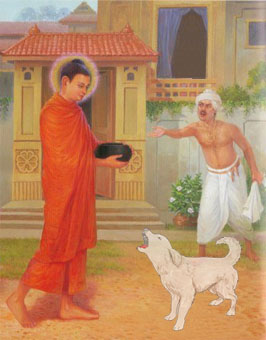 One day, taking His almsbowl, the Buddha passed by the house of the Brahman and was barked furiously by his white dog. It so happened that its master Subha Manava had been out, the Buddha stopped the white dog’s barking by calling its trivial name of its past life. The Buddha looked at the white dog and said, “You should not bark at me like this! You ought to have known that you had ever been a man, who could talk in your previous life, but now you become a dog and you can only bark.” Hearing the Buddha’s words, the white dog was obviously able to understand the meaning of what the World Honoured One had said and hatred as well as anger arose in its mind. It leapt out of its bed, lay on the ground near a pile of wood and was in a bad mood. Seeing his white dog in such a low spirit that it looked as if it had been made annoyed by somebody when returning home, its master Subha Manava asked his servants for the reasons. Subha Manava had ever treated his beloved pet dog like having a pearl in the palm. Knowing that the cause for his dog’s sadness was due to what the Buddha had said to it, Subha Manava could not help but feel infuriated and he immediately headed towards the Jetavana Vihara(monastery)to question the Buddha why He had made his beloved dog blue. The Buddha then told him the entire incident that had happened