
Can Good and Evil Neutralize or Offset Each Other
| A female disciple has incessantly been making trouble (unintentionally and unrestrained) during group cultivation classes for more than ten years. She is really a ‘trouble-maker’. Rinpoche, who always has mercy on every single sentient being, has been civilizing her over the long period of time according to the basic doctrine of Klesa (a Sanskrit word, means affliction) is equivalent to Bodhi (煩惱即菩提). One day, ignorance arose again from the female disciple. She released a specious fallacy on a certain matter boldly and assuredly in front of all fellow disciples in the class, “Doing everything with good intentions and benevolence as starting points, I don’t expect that it becomes ‘the road to hell is paved with good intentions (to mean well but do bad things)’. Well, I’ve ever done so many good deeds that I’m sure they can serve to balance (counterbalance) the evil karma I’ve made.”
All of us were in an uproar after hearing such nonsense words except Rinpoche who was having a light smile (which told us to take it easy) instead. He then gave us a discourse by means of an analogy, “One day, senior fellow Dharma-brother left the Centre with two siblings (brothers). As soon as they turned left from the main street, they came across an utterly disgusting guy who was staring at senior fellow Dharma-brother with his eyes wide open (i.e. in a rude way). Failing to beside himself, senior fellow Dharma-brother, who was flared up with anger for no reason at all, surged quickly towards the guy and pushed him over onto the ground without saying anything further. The two siblings also acted so cooperatively that they ran immediately towards the guy and clasped him tightly. They then punched and kicked the guy together until he was unable to move, but fell lying by the side of the pavement. The old woman was completely confused and asked, “What do you want to balance with?” |
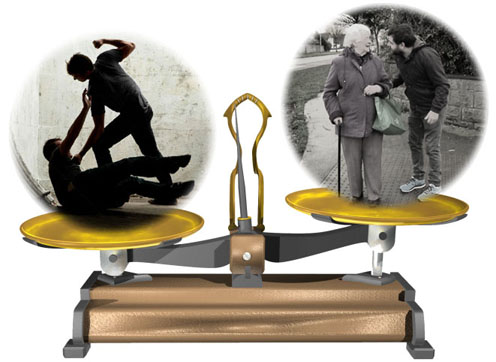
| Rinpoche, whose discourse every time is filled with profound as well as subtle Buddhist allegory, stood up and left after finishing the analogy. Having heard the discourse, the female disciple looked rather confused. It seemed that she was entirely unable to understand or catch the metaphor of Rinpoche’s discourse just now. Senior fellow Dharma-brother, who was so happen to be right by her, could not help laughing and explained immediately, “Ha-ha! Ha-ha! First of all, I didn’t hit anyone with the two brothers! Rinpoche simply thought of inspiring you and hoped that you could come up with |
|
| 1. | Create no evil and cultivate all good (諸惡莫作,眾善奉行)! One must notice that it is ‘create no evil’ which is sorted as the first sentence. It means that this sentence is of great importance and it is the foremost thing that all Buddhists have to do well. Do not forget that it is the Buddha’s instruction which is also part of the essence of Buddhism. |
| 2. | What goes around comes around (善有善報,惡有惡報). Thus, merits and demerits cannot offset each other. If they could mutually be counteracted, why would there still be the existence of causality? Why would one still dread cause and effect? One need to know that ‘Bodhisattva is fear of (sowing) the causes while sentient beings are afraid of (bearing) the effects’. |
| 3. | One can merely hope for little retribution (in return) for big evil karma done! |
| 4. | Read the predestined causes of the Buddha for reference. Having said something wrong before His Enlightenment, even the Buddha needs to undergo the correlated retribution in person after His attaining Buddhahood! Hope that you can be cautious in speech so as not to say anything nonsense.” |
| Senior fellow Dharma-brother sighed with emotion and continued, “Fellow Dharma-sister, you’ve been indulged in Tantric mantras and mudras for more than twenty years. Nevertheless, you’ve ignored Rinpoche’s wisdom discourses on you, looked down on the fundamental principles of both Exoteric and Esoteric Buddhism as well as cold-shouldered to Dharma brothers who have given you admonitions. Instead, you’ve only been crazy about the secular way of controlling and domination. Sometimes, I do think that you’re really very lamentable and pathetic. Learning Buddhism for such a long time, your improvement is very, very slow or it may be said to have no progress at all. In fact, you even don’t possess the essential bases of Right Views. All these are related to your (undesirable characters): content with staying where you are (complacent and conservative 故步自封), building a cart behind closed doors (working on some projects without reference to what the reality requires 閉門造車) as well as having your head up in space (proud and arrogant 心高氣傲)! You said that everything you’d ever done was filled with good intentions and benevolence as starting points. However, you’ve forgotten that the motive powers behind whatever you do are actually ‘raga (greed), dvesha (aversion) and moha (delusion)’. Besides, you also said that you’d done lots of good deeds. The so-called ‘good deeds’ are all measured with your own ruler (from your own point of view) rather than that of Buddhas and Bodhisattvas’/Rinpoche’s. Perhaps, what you’ve done are so insignificant that they are not worthy of mention since there is quite a long distance to go before your acts can be regarded as cultivating the Bodhi Path! This distance is exactly the separation between Buddhas as well as Bodhisattvas and ordinary people. You should calm down to contemplate more instead of behaving like thick branches and big leaves --- crudely and carelessly doing whatever you want irrespective of the consequences. Presuming that your starting point is right, you do not only do what you like in an imposing manner, but are also hell-bent on clinging to your obdurate course. You seem to have too much greed, aversion and delusion that makes your mindset go in a wrong direction. You’d better spur on, spur yourself on!” | |
